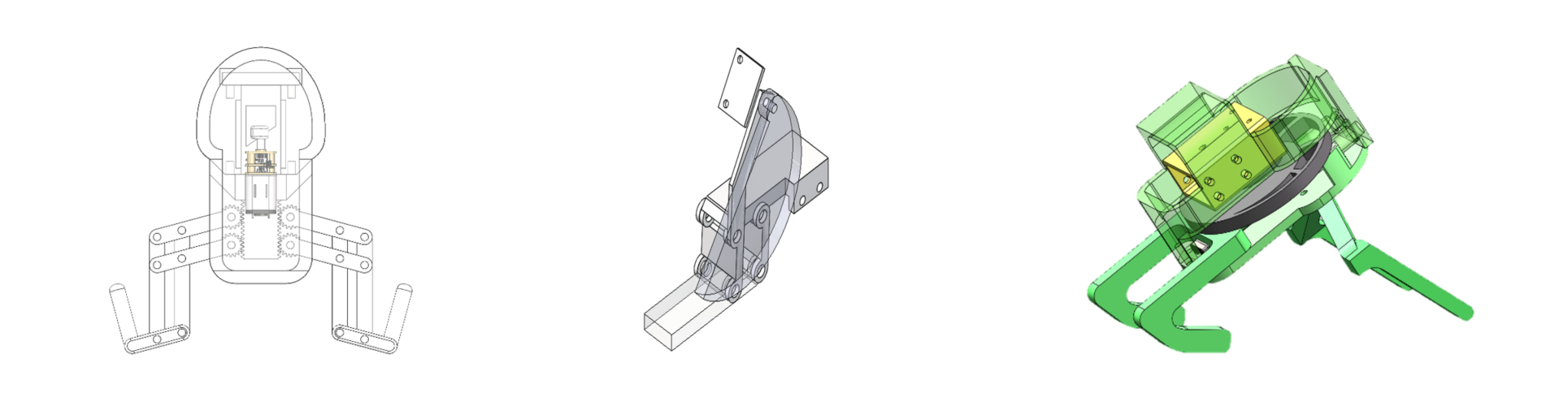
Bionic Frog
Abstract
We designed a remotely controlled bionic frog jumping robot. The energy storage mechanism utilizes a cam-driven linkage to compress the spring, and remote control is achieved through Wi-Fi or Bluetooth connections. Within the specified dimensions of the project, it has achieved a jumping distance of greater than 52cm.
Requirements
This project is targeted at the 11th (2024) National College Students’ Mechanical Innovation Design Competition. The bionic frog’s appearance has the following size restrictions:
- Static size does not exceed 0.1m * 0.1m * 0.1m
- Size after jumping deformation does not exceed 0.2m * 0.1m * 0.1m
- Total weight does not exceed 4kg
- Mechanical energy cannot be stored in advance before the competition, and the jump must be completed within 30 seconds.
Mechanical Design
If a bionic frog needs to complete a jumping action, three key mechanical structures are needed:
- Driving mechanism
- Energy storage element
- Energy locking and release mechanism.
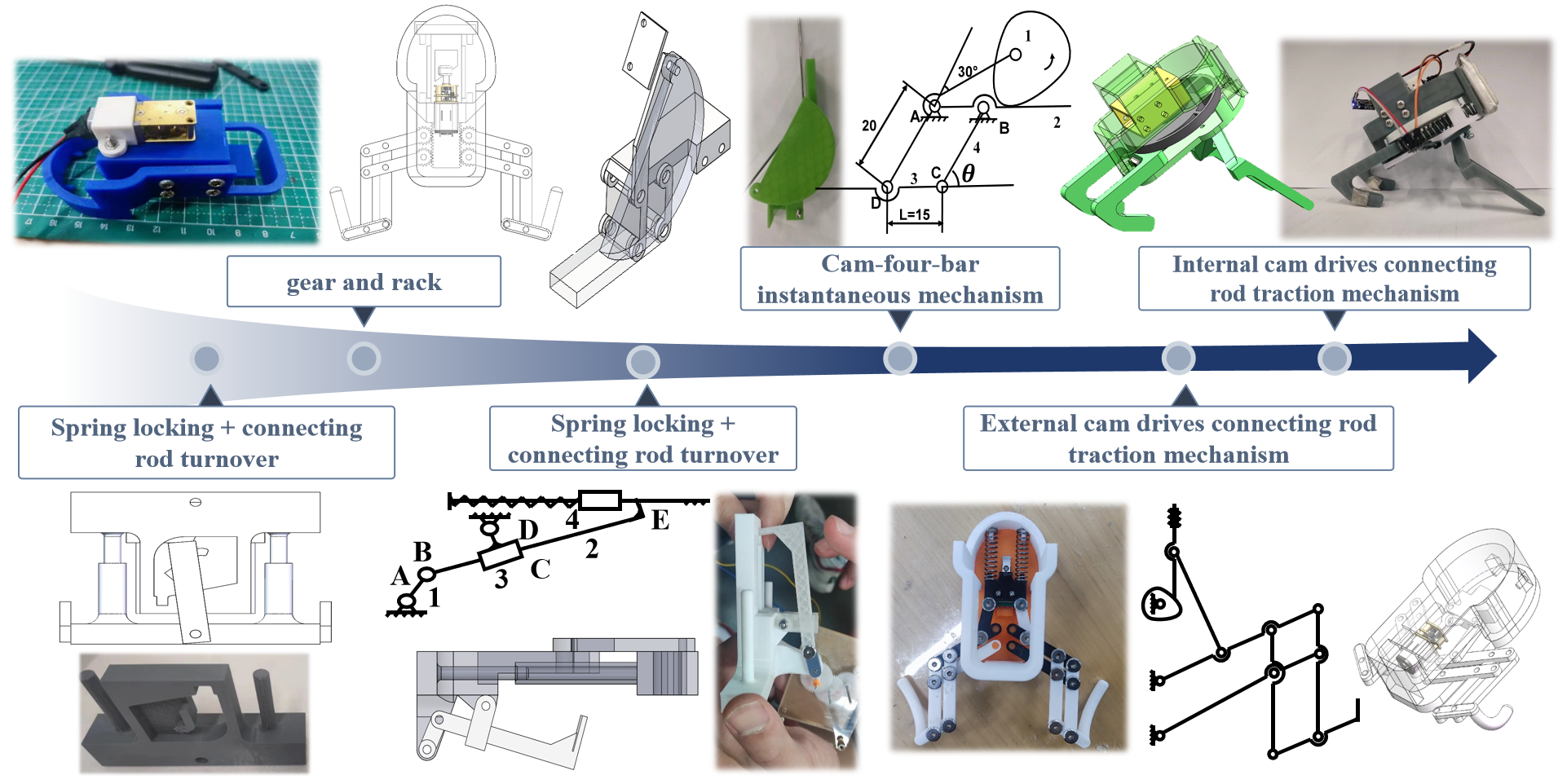
We made many iterations of the mechanical structure of the bionic frog. The final implementation version is: using springs for energy storage, and using internal cams and connecting rods to achieve driving as well as energy locking and release.
Measure System
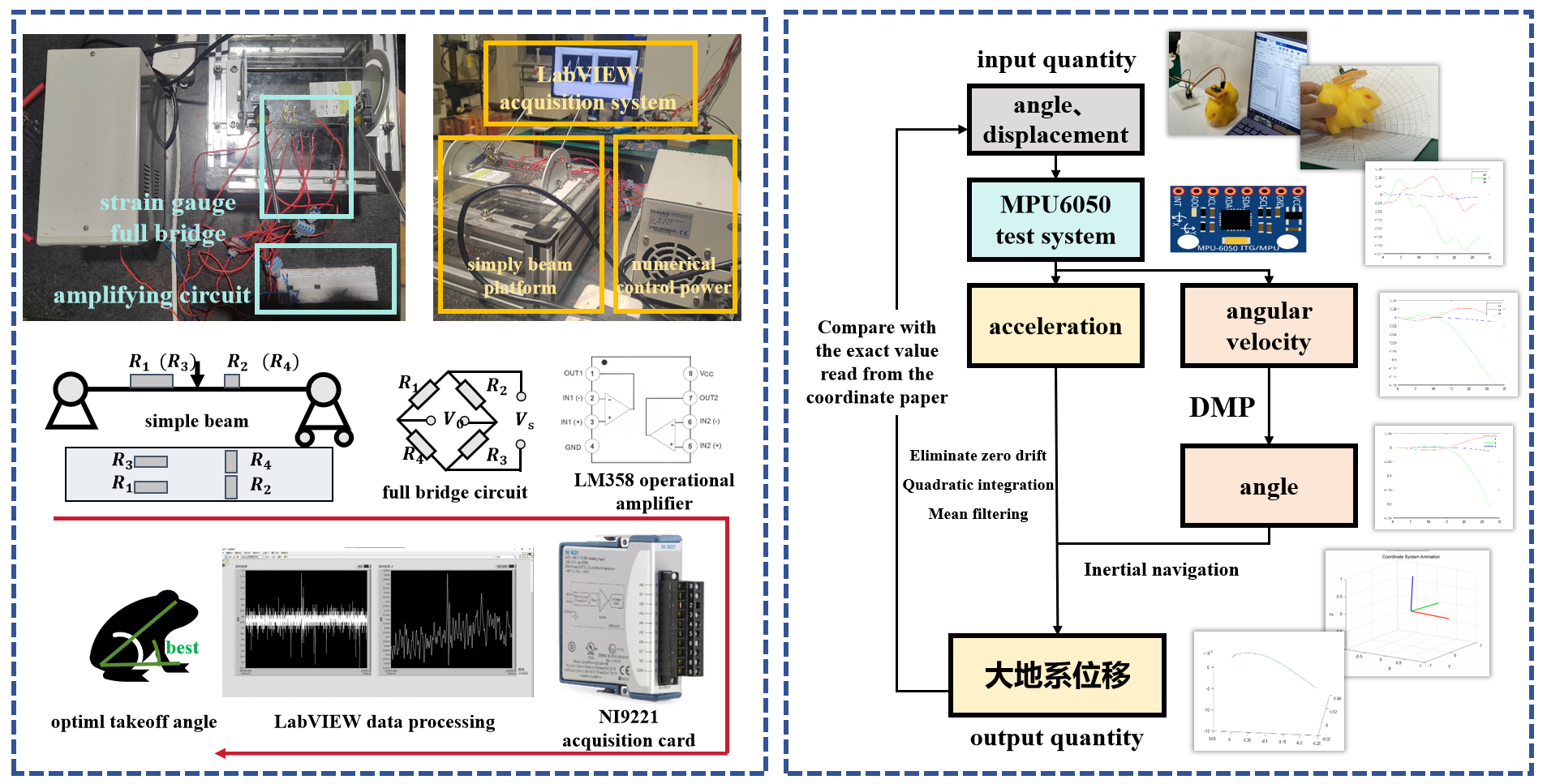
To measure the relationship between the frog’s takeoff angle and the vertical force exerted on the ground, we have constructed a test platform as shown in the figure. The frog is fixed on the guide rail through a fixing device to achieve a specific takeoff angle. The jumping board is equipped with two transverse and two longitudinal strain gauges. By using a full-bridge circuit of the strain gauges, an external amplifier, and an NI9221 data acquisition card to collect data, filtering is performed in LabView to measure the strain.
Final Results
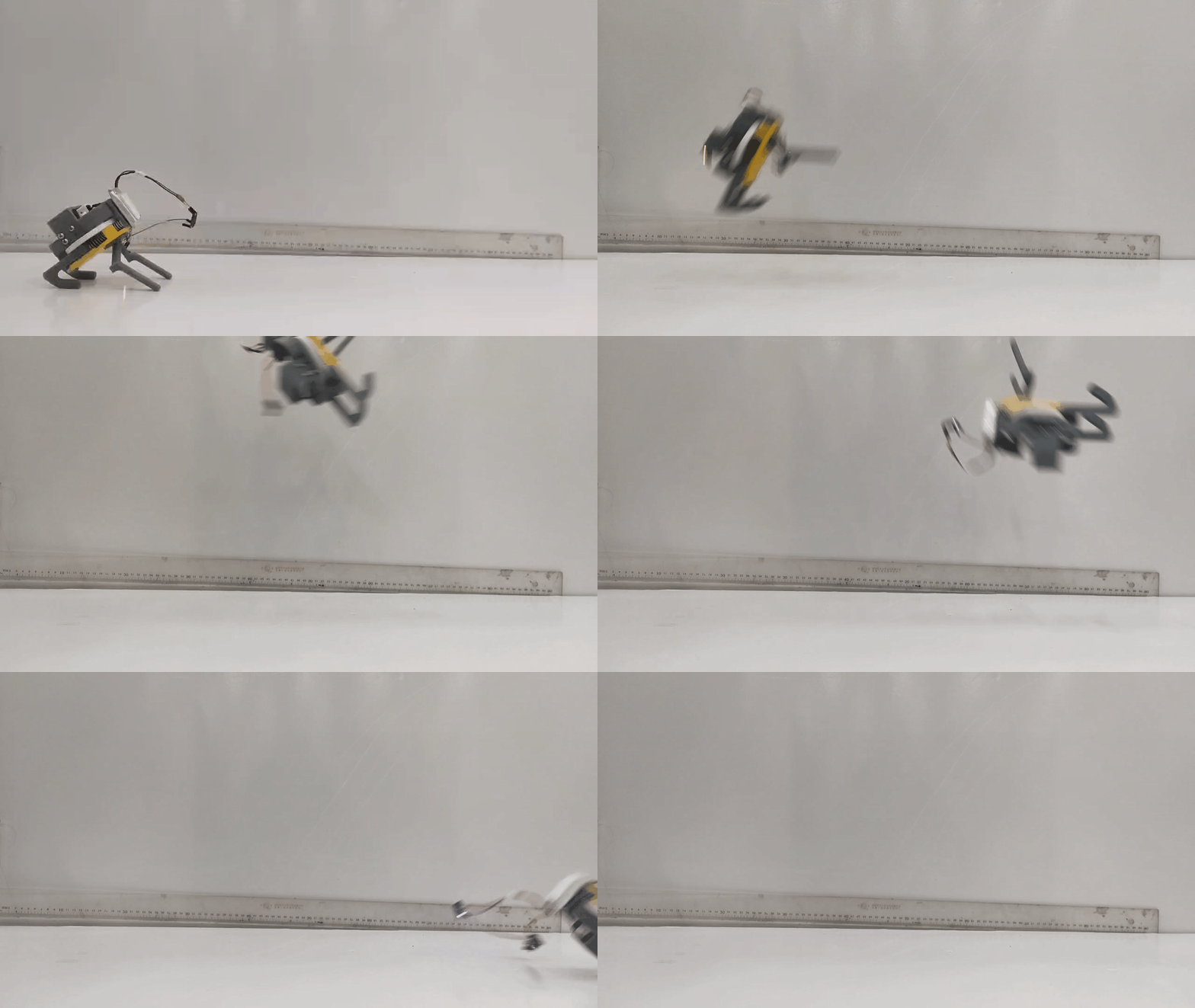
Finally, our bionic frog meet the requirements of external dimensions, and it’s weight is controlled at 156.3 grams, and the farthest jumping distance > 52 centimeters.
Publications
- Project Demo Website https://me.sjtu.edu.cn/bkjx/me3220/Projects2024/712.html